
Jared Dustin Griffin
The Perseverance of Sisyphus
Out Now on First City Artists
-
-
The story of Sisyphus and his unceasing duty to roll a boulder uphill is well-known. What the story symbolizes, an unending endeavor in vain, is likewise familiar, perhaps even intrinsic to the human condition. What goes less acknowledged, even as the term “Sisyphean” flows freely through pop culture and everyday conversations, is the actual wisdom that story is intended to impart: Find splendor in the pursuit, find meaning in the suffering, find beauty in the struggle—regardless of whether or not your boulder rolls back down the hill.
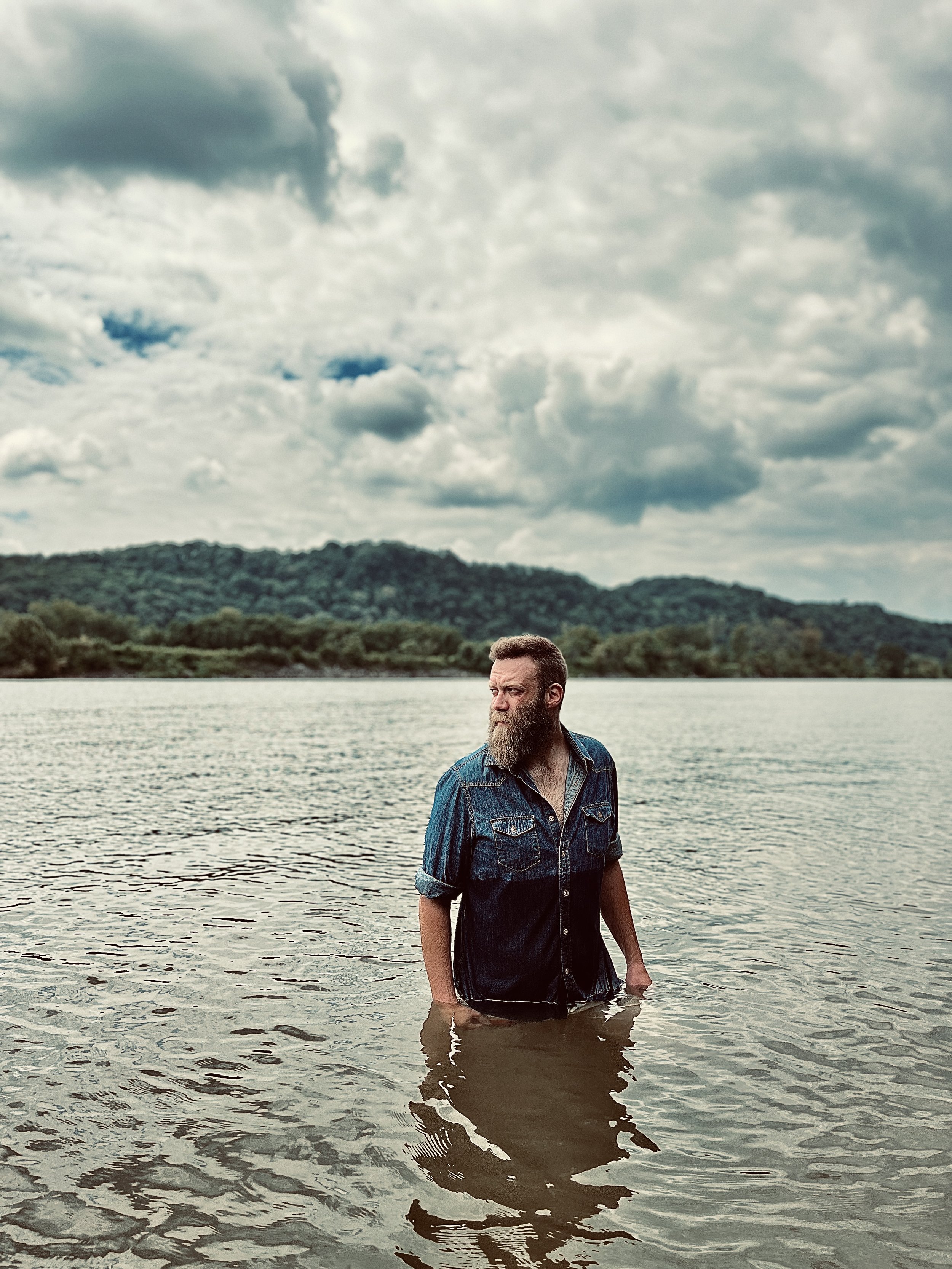
Jared Dustin Griffin took the hint. His sophomore album ‘The Perseverance of Sisyphus’ draws upon two decades of commitment to making music, as well as the untethered and at times precarious lifestyle that required. It’s a look back at a long journey with allegedly little to show for it—exempting, of course, a nourished soul, a passion fulfilled, and a life honestly lived. The album opens with “I am the Cavalry,” a poetic retrospect and ode to the power of recognizing one’s own sacrifices and moving forward with grace: Onward through the valley ahead / The shadows shed light where the river bends / I carry the sick and I bury the dead / And make peace with my suffering.
Growing up in San Francisco, Griffin’s desire to write songs took hold in his late teens with the discovery of Neil Young and The Who. He developed an obsession so intense he nearly flunked out of high school, helplessly hypnotized by the spin of a portable CD player. “I’d skip class and sit on the beach with my headphones on, listening to 'Tommy’ or 'Quadrophenia,’” says Griffin. He made it through and enrolled in college, only to drop out on four separate occasions, the ultimate departure largely due to a wholly consuming love for Bob Dylan. “I wanted to be a songwriter,” Griffin says. “I couldn’t think about, or pretend to think about, anything else.”
Over the course of a year, Griffin taught himself to play guitar and to sing, the latter of which he admits didn’t come easy. “I didn’t know my own voice yet,” he says, his endearing humility ever-at-play. “It wasn’t until I heard Tom Waits, and really, Howlin’ Wolf, that I realized you could sing with a voice like mine, that I didn’t need to change anything about it like I’d been trying to do.” Griffin has the kind of gravelly, reverberating baritone that is in itself evocative, an elegant melancholy tucked into every rasp. “I was twenty-five when I finally learned to embrace the roughness.”
He spent his twenties in motion—playing in rock bands; sleeping on couches, floors, benches; battling alcoholism and addiction; assuming all volatility as the requisite toll for a life dedicated to art. “Relationships, physical comfort, emotional stability, financial wellbeing—the dream can take everything from you,” says Griffin. “I guess I always had the choice to stop, but it never felt like an option. Not a real option.” In his early thirties, he came very close. He was living in Tulsa, in a van repeatedly broken into, and hadn’t written a song in a year. “I was looking around and seeing everyone who I’d come up with give in to different lives.” He moved back to the Bay area and took on day jobs, entertaining the notion of a more stable direction. As the pressure lifted, the songs came out—in floods. “I wrote a couple hundred songs over the next few years, and they were my best to date.” It was also in this phase that Griffin met his staunchly supportive producer, Brian Brinkerhoff. Recalling it all, Griffin’s voice rounds out with confidence, a fervent faith in perseverance. “It took me fifteen years to write lyrics that I’m really, truly proud of.”
The songs of ‘Sisyphus’ dwell in the sacred shadows of Leonard Cohen and Townes Van Zandt, gritty but reverent, rugged but vulnerable. When asked as a child what he wanted to be when he grew up, Griffin declared “ghostbuster” with adamancy. “Not just for a fleeting moment either,” he clarifies. “For at least five years of my childhood, that was the plan.” He laughs recalling this, but in his ardently fought-for vocation of songwriting, he’s not far off. Griffin’s lyrics often linger on death and its companion spiritual world. The album feels spectral, ancient, even biblical at times. His lyrics lean theological—summoning the angels, the devil, the blood of lamb—but Griffin’s devoutness pertains to the inherently holy experience of man. As in standout song “Shook,” he illuminates the unrelenting rigor of simply being alive: It's never really gone / The things that we’ve been through / Life has shook me just like it will shake you.
Album centerpiece “Bags of Bones” is a masterwork of emotional intensity, written as, in Griffin’s own words, “a portrait of relentless drive, a body rattling in pursuit of perfection, and the cost of giving everything to the muse.” The song evolves from the wiry weep of a solitary fiddle into a cinematic chorus of human anguish. You said we’re born just to die here / So the little I do / The little I don’t / It won’t mind us. There’s an ache to the sentiment, to the futility of one’s search for meaning. But as Griffin’s honeyed bellow echoes and grows, joined by soulful harmonies, sublime piano flourishes, and rapturous strings, there’s also a sense of relief—even celebration. What begins as a lament ends as an anthem, an exhilarated embrace of mortality, of the arbitrariness of existence.
Griffin’s music is visceral—in its lows and its highs. “Turn Me Loose” is a proper Bluegrass romp, driven by frenetic fiddles and mandolin. “Howl at the Moon” arrives in the latter half just when a listener needs it, a bright and jangly dance break in the freedom darkness provides. “It’s a song meant to shake the dust from the album’s journey—” Griffin says, “—a reminder that sometimes the only way to cope with the weight of the world is to let loose and howl.”
Something between a nomad and a vagabond, Griffin has called a list of cities home— Reno, New York, London, Tulsa, Edinburgh, and Portland to name a few. He is currently based in Topeka, though he doesn’t know for how long. He feels neither regret nor reluctance about the transient life he’s lived—the strife has made his character all the more dogged, his artistry all the more storied. “I’m as grateful for the bad songs, the tough gigs, the hard nights, as I am for any of it,” he says. “The artistic pursuit is just that—a pursuit.” For Griffin, the boulder isn’t the problem. It’s the point.
-
-
press: maddie@luckybirdmedia.com
label: maddie@firstcityartists.com
sync: dhigbee@dualtone.com
general: jareddustingriffin@gmail.com