
JP Harris
Shaving A Dead Man
Out October 23 on Bloodshot Records
-
-
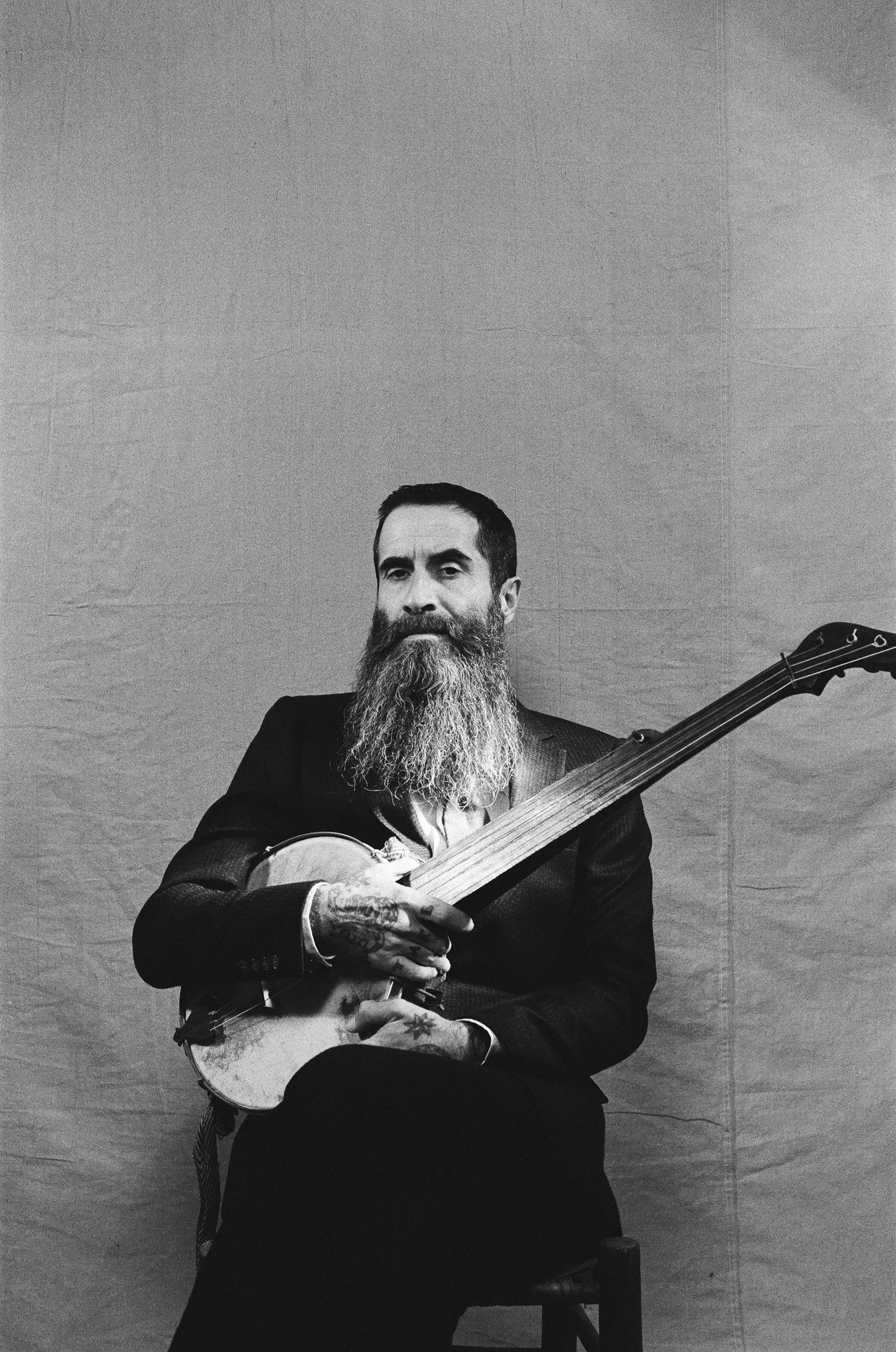
As it drowns in toxic tsunamis of top-down propaganda and bottom-up “content,” America needs its dissidents, punks, rebels, and rounders more than ever. What’s left of our free-thinking people are crying out for tradition keepers and cultural guerrillas, for throwbacks, iconoclasts, and mavericks. Made for these times, ergo, is JP Harris, his voice, and his banjo.
Known to many across the honky tonks of America as a craftsman of electrified outlaw country music, Harris has recently been singing an older song, calling on the music that changed his life twenty years ago. With 2022’s Don’t You Marry No Railroad Man and the new 2026 opus Shaving A Dead Man, JP Harris embraces and exuberates in Appalachian old-time music with a history and integrity that confounds the 21st century’s dystopian decline. The repertoire is heirloom, but the performances by Harris, alongside fiddler Chance McCoy, have a subversive power and a healing, analog humanity.
“Old-time music has been a baseline for me,” Harris says. “And I think in getting a little older, a little more comfortable with myself and trusting my intuitions a little more, I've realized that one thing that's never changed in the tumult of launching and trying to build and maintain a music career all these years, the one consistent love and lover that I've had has been the old-time community.”
Shaving A Dead Man reflects a passionate and personal interpretation of tradition, not some scholarly survey. As with any quality folk music, the collection has a sense of place, specifically the studio where it was recorded in Monroe County, West Virginia. Owned and operated by McCoy (lately with Old Crow Medicine Show), Hunter Springs is an idyllic rural retreat. Not only has JP recorded there before, he helped build it. Prior to recording Don’t You Marry No Railroad Man, Harris and McCoy turned a sharecropper’s shack into a workable studio, ultimately upgrading it into the world-class space it is today.
For these latest sessions, there were no trenches to dig, no power cables to lay, no hammering in the winter wind. It was a lot easier to get down to the music-making.
The songs - including “Rousatabout,” “Pretty Saro,” “Say Darling Say” and “Hog Eyed Man” - have provenance, and Harris shares that information in the album notes, in keeping with the folk tradition of knowing one’s source material. For anyone who’s been around old-time music, they’re familiar tunes, not an effort by Harris to show off his knowledge of the art form’s arcana.
“There's a reason that those tunes are still around and the obscure ones are the obscure ones in that, you know, these are ones that maybe have a more catchy melody or something really poignant in the lyrics that really stick with people,” Harris says. “I didn't want to go so far off into the ether that it became unidentifiable to people. I want this to be listenable and attractive, because the whole purpose is just preserving it and hoping that it opens the door for more people.”
JP’s story is positively Steinbeckian. Raised between Alabama, the Mojave Desert, and Las Vegas, he set out on his own at 14 years old with an eighth-grade education, building himself a life of traveling, punk rock, and trades as varied as shepherding, heavy construction, logging, banjo building, and historic restoration carpentry. His first taste of settled life was in rural Vermont, where JP lived for years with no power, wood heat, and water drawn from a spring.
Along his way, swapping cassette tapes opened up new worlds to JP, including classic country music and traditional Appalachian picking and singing. He discovered the old-time convention and festival circuit - Clifftop, Galax, The Harry Smith Frolic - finding his place in the camaraderie and the music’s trance-like wonder, often picking until sunrise. He felt at home, and during stretches, he followed the scene like a gypsy caravan. “If you're gonna eat canned beans and sleep in the back of your truck, you could go for months on end and never not be somewhere playing old-time music,” he says, having lived it.
Harris moved to Nashville around 2010 and took up what could be described as a more conventional working life. He’s restored houses all around his home base of East Nashville and applied his skills to several recording studios besides McCoy’s. In parallel, he built a music career, playing original, steel-guitar honky tonk with his band the Tough Choices. He released five albums in twelve years, including 2018’s Sometimes Dogs Bark At Nothing on Free Dirt Records, which won the Independent Music Awards’ Country Album Of The Year. He emerged as a leader of the East Nashville music underground, a mentor to precocious talents like the late Luke Bell, a fixture at the American Legion’s Honky Tonk Tuesdays, and a curator at the Newport Folk Festival and AmericanaFest. Chroniclers have called Harris “a gothic banjo bard” … “a Telecaster-slinging and leathery shit kicker”... and “a natural reinterpretor of traditional song.”
As for Shaving A Dead Man, with its Americana gothic drones and whimsically macabre cover, Harris says it’s “like coming back around to an old friend who's been there the whole time.” Newcomers to the old-time genre will hear a hypnotic snap and sway in the silvery plunk of JP’s banjo, a spectral, bluesy emotion in McCoy’s fiddle, and songs with lyrics that conjure something mythical, mysterious, and sometimes murderous. Thing is, our heritage lives in those verses, and it’s up to all of us to find it and make that history our own.
“I just turned 43 in February, and trying to get one more rung up on the commercial performing ladder of country or Americana music isn't really something I'm looking to expel calories doing,” says Harris. “This album offers an identifiable element to people who want to access old-time, not necessarily through Smithsonian field recordings. I'm not just some museum-quality reproduction piece. Planting this flag in the mud is saying that I’m still a fringe element, even if I am a traditional roots musician. It makes it identifiable to the next generation of little weird music kids like me.”
-
-
-
press: maddie@luckybirdmedia.com
mgmt: nataliejordanmgmt@gmail.com
label: kenny@bloodshotrecords.com
label: corinne@yeproc.com
booking: logan@odyssey-touring.com