
THE MONTVALES
PATH OF TOTALITY
FREE DIRT RECORDS
-
-
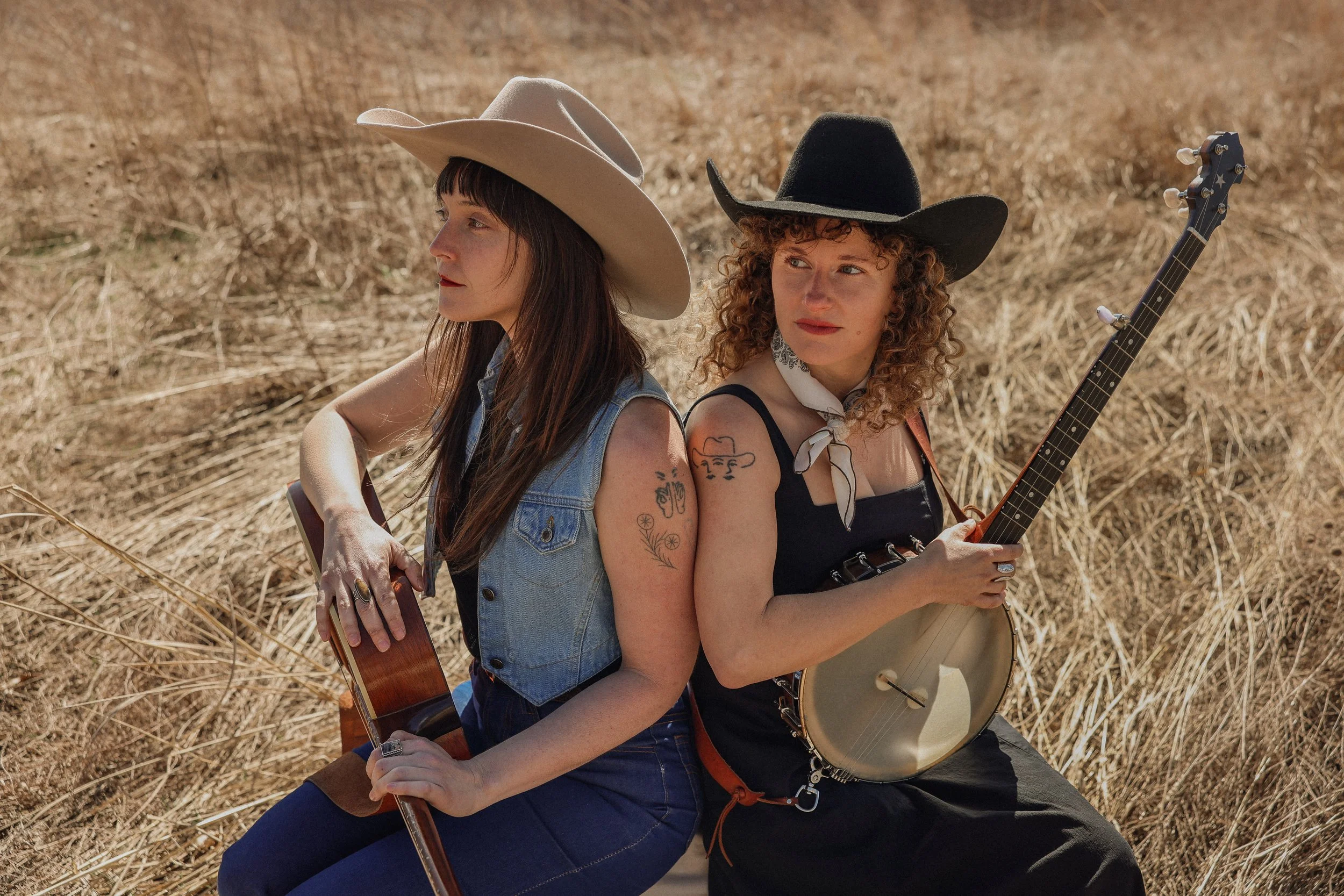
A total eclipse is a rare phenomenon when dark and light converge. Strangers lift their faces toward the perfect circle in the sky, and, for a moment, the world around us quiets and all divides erase. It’s a reckoning similar to the one Americans now face: a reminder that, however different we are, we share the same shadows and the same fragile earth. The traveling musician knows this well. They absorb the people, experiences, struggles and successes they meet along the way like devoted historians. Such is the case on Path of Totality, the third full-length album from Cincinnati-based folk duo The Montvales (coming March 20, 2026 on Free Dirt Records).
Like so many traveling musicians before them and so many still to come, Sally Buice and Molly Rochelson make their way from city to city, committed to understanding the world and documenting its tribulations. Conceived under eclipsed skies during a tour from Pittsburgh to Texas in April of 2024, Path of Totality unites the vast American diaspora by weaving us all into one collective and cosmic tapestry. Inspired by a long tradition of radical country and folk artists (Woody Guthrie, Indigo Girls, John Prine, The Chicks), The Montvales use their passion for literature and storytelling to craft an album that reckons with the current global fever pitch. The album’s twelve introspective, thematically and sonically layered tracks chart a transformative pilgrimage through an inextricably connected world at odds.
When The Montvales embarked on their tour from Pittsburgh to Texas in the spring of 2024, their route inadvertently matched part of the path of totality for a total solar eclipse across North America. The effect was surreal: they met people from all over the world in each rural gas station, everyone buzzing in anticipation. Traffic was intense. Suddenly every hotel room cost twice as much as usual. But the omen echoed far greater than just the path of totality. Rochelson, who applies astrological symbolism in her daily life, explains an eclipse is said to bring dark, shadowy material to the surface-often confronting us with difficult truths. In the spring of 2024, student demonstrations across the country called attention to the unfolding genocide in Gaza. Many Americans suddenly grappled with a deeper understanding of the suffering their tax dollars were funding, amidst a skyrocketing cost of living. Neither of the front runners in the impending presidential election seemed to have much to say about it. American democracy felt more tenuous than ever, and the threat of a second Trump term hung heavily in the air.
On a personal level, the band also happened to be undergoing a rather dramatic streak of bad luck. Rochelson, while trying to clear her head on a walk along the Galveston Bay, wrote the album’s striking opening track “World of Trouble.” “We were about to play the Old Quarter and I thought about Townes and Guy Clark and what it meant to be in this role of traveling stranger and cultural witness during such catastrophic times,” Rochelson says.
Just like Rochelson’s inspiration came while retreating to a walk along the water, Buice also relies on time in wild places to fuel her creative clarity. In an impulsive fit of blind optimism in late 2020, Buice hopped in her old Toyota Camry and traveled from Tennessee to Colorado to work as a wrangler on a ranch. Buice lived and worked on 100,000 acres along the foothills of the Rocky Mountains, borrowing the privilege of caring for horses, cattle, bison, and land. While reflecting on her decision to become a wrangler, Buice wrote the retrospective track “Hellbent on Colorado.”
“Retreating to nature and farm work tends to allow me the space to unearth themes and start turning them into songs,” Buice explains. “The cycles of life and death on the ranch reminded me how pretty much everything is only borrowed for a time.” Even her time in Colorado was borrowed; she later moved to Cincinnati, sold the Camry for parts, and hung a picture of her favorite ranch horse on her apartment wall.
Place and fate resonate throughout Path of Totality. Raised in the staunchly conservative state of Tennessee, Buice and Rochelson were outliers, destined to meet before they were even born. Their parents were family friends and former co-workers who nurtured their creative children and taught them the importance of empathy and community. Home to the Highlander Center, a historic social justice organizing space, and a diverse and busy Market Square in Knoxville, their East Tennessee community was a hotbed for political movements and for the arts. The duo took to Market Square in middle school to kick off their busking career, performing alongside all sorts of entertainers in the robust chaos of the commons.
“It was a really inclusive scene. It felt like there was a little bit of everything; it wasn’t super competitive or polished or anything,” Rochelson remembers. “It didn’t really feel like there was any barrier to entry.” The community embraced the pair’s musical pursuits throughout their youth. They jumped around from genre to genre, playing roots music with punk and old-time influences to craft their sound and message. “We are on the feral outskirts of country music,” Rochelson says.
Their politically-driven songwriting is heavily informed by their upbringing in the South, witnessing the tenacity of people organizing for liberation under violent and tumultuous conditions. The Highlander Center was set on fire and faced several bomb threats, there was a politically-motivated shooting at their Unitarian Universalist Church, and the Planned Parenthood where Rochelson worked was burned down. Reminiscing on the lyrics to John Prine’s “Your Flag Decal Won’t Get You into Heaven Anymore,” Buice explains that politically driven folk music gave her a sense of agency in dark times, and she’s always wanted to be part of that musical lineage.
“I’ve always thought that would be the best possible way to do music,” Buice says. “I don’t always set out to convey a particular message. I think it works better to see how politics obviously informs everything about our lives, and braid that into the songs.”
Path of Totality does not shy away from the weight of political strife and catastrophe, opting instead to boldly confront it. The Montvales ask us not only how we will endure despite our differences, but how we will find each other again. Their songs are descriptive and textured. The characters are vivid. Their stories are crucial.
Survival is a common theme throughout Path of Totality. In “Runaway Horse” and “Overtime,” Buice laments the energy necessary to survive as a touring musician, woman, and family member in a state stacked against working folks. Due to the gentrification of Knoxville, both Sally and Molly felt pushed out of their hometown in search of a more affordable city. The duo migrated north to Cincinnati, inspired by punk-folk crusaders The Tillers who had built meaningful careers there. It wasn’t long before the Tillers, who maintain a reputation for lifting up new artists in the area, invited them play at Southgate House Revival, where they became regular performers.
While their own struggles lend emergent political and social commentary throughout the Path of Totality, they also introduce other ambitious characters, both real and fictional. A woman desperate to save her community from a gas pipeline in “Plains of Ohio,” a devout grandmother traveling across the world to Yugoslavia in search of the Virgin Mary in “Our Lady,” and a trouble-making Bible College misfit in “Loud and Clear” are just a few of the archetypes listeners meet. The Montvales depend on storytelling and narration to foster solidarity in a polarized world. The album skillfully and emotionally bounces from love song to lamentation, a testament to their growing musical dynamic.
The Montvales recorded Heartbreak Summer Camp, their first album, with just the two of them in a living room. “That’s how we knew how to play the songs and we didn’t have any money and so that’s how we did it,” Rochelson says. The stripped-down, DIY folksongs span their young adulthood, beginning in their teens and taking them through their mid 20s. “I’m really glad that we have that record as a document of that time.”
Seeking a more polished sound, the duo recorded their next album Born Strangers at Sean Sullivan’s Tractor Shed Studio in Goodlettsville, TN, and sought out Mike Eli LoPinto (guitarist for Chris Stapleton and Wyatt Flores, producer of Emily Nenni's On The Ranch) to produce it. LoPinto brought in a band of players to help translate the duo’s songs into a much broader, collaborative sound. The Montvales brought LoPinto back for Path of Totality, this time recorded at Jesse Noah Wilson’s Rancho Deluxe, a cozy home studio complete with cats, dogs, and horses galloping just outside. The flexibility allowed them to stray from their traditional folk duo set up, while also listening to Hurray for the Riff Raff and James McMurtry for inspiration.
“There are definitely more electric guitars on this record,” Rochelson laughs. They flirt with folk, country, and indie sounds, combining dark tones with emotional vocals throughout the album. LoPinto leant guitar and banjo, Mary Meyer accompanied on fiddle, mandolin, guitar, banjo, and vocal harmonies, Aaron Goodrich sat in on drums, Eddy Dunlap brought a cool direction with pedal steel, and Jesse, who mixed and engineered the album, played keys and bass. The result is a bonafide, left-of-center indie pop country record, imbued with the wildness of the times. “It’s a document of us just entirely giving ourselves up to the process,” Buice says, “literally and metaphorically putting ourselves in the path of totality in pursuit of wholeness.”
The Montvales rely on a creative trust built over many years and various twists of fate that keep bringing them back together. The pair now live only a couple of blocks from each other, and sometimes their connection feels telepathic: things that Buice has only thought about end up in Rochelson’s dreams. As cowriters, this depth of connection affords them the courage to explore even the most vulnerable, shadowy inner terrain.
There’s no halfway in, they write in the track “The Wicked.” Together, The Montvales are devoted to redefining success outside the paradigm of linear time and capitalist construct by relying on their intuitive energy. “So what if we’re doomed here, now, this time? We’ll just find each other in the next round and pick up where we left off.” Just as rare and as juxtaposing as a total solar eclipse, with Path of Totality, The Montvales unleash a phenomenal, cosmic American tableau for modern times with the power to unite us all. -
-
press: jake@luckybirdmedia.com
booking: dani@rowboatmusic.com