
Sahara Grim
Fable
Out Now Independently
-
-
Well, if life’s a joke / The joke was on me / Like a fucked up dream / It’s reality
Quotations tell us that Henry David Thoreau went to the woods “to live deliberately, to front only the essential facts of life.” John Muir, on the other hand, went to lose his mind and find his soul, to climb the mountains and get their good tidings. Sahara Grim, when asked about her own motivations, went to the woods to regroup. After graduating college amidst a global pandemic, hitting a hard stop in the development of her music community, and feeling suddenly uncertain about the path forward, she looked to the earth for fresh lore. Listening to the album which emerged in the spectral company of trees, it’s easy to imagine she experienced what those other guys describe too.
Produced by Luke Temple (Adrianne Lenker, Hand Habits), Sahara Grim’s Fable is a vibrant work of worldly indie pop—sensual, mystical, and groovy. Compared as easily to Kate Bush as Alice Phoebe Lou, her sound ranges from witchy to lulling, richly textured by her ethnic roots in India and Japan. Sahara learned to play guitar as a child and cites Little Dragon, St. Vincent, and Joanna Newsome among her earliest influences, whose offerings she happily mined for on Myspace and Tumblr. By adolescence, she shifted her focus to Jazz, Bossa Nova, and Neosoul, elated by what she calls “colorful chords” and artists like Esperanza Spalding, Hiatus Kaiyote, Moonchild, before expanding into the worlds of Indian, Brazilian, and Middle Eastern Classical. It’s no wonder classifying her creations is a mystifying task. Sahara completed a degree in World Music & Jazz from the Herb Alpert School of Music at UCLA but is eager to declare, “You don’t need to go to music school to make music.”
That dissonance between expectation and experience was one of many in Sahara’s early adulthood. Leaving the city, she had a collection of disillusionments—in friendships, romance, and even her self-perception—to sort and reconcile. Her woods of choice were in Carmel Valley, just across the mountain from Big Sur, where an eclectic cohort of artists, including French artist Melody’s Echo Chamber and harpist Lynda Jardine, take refuge.
Emerging from the chaos of Los Angeles, she began to consider solitude—for which Fable’s opening track is named—“a sacred gift.” She needed distance from the physical, external frenzy in order to distinguish the frenzy within, and begin making sense of it. “In seclusion, I felt safety and warmth, reconnecting with my own energy after years,” she says, and on “Solitude,” puts this sensation to sound. The album opener is spacious, slow, and softly glimmering—a nearly eerie come-hither, inviting listeners to leave the crowded fuss of normalcy and enter an enchanted new place.
There, the story of Sahara’s struggle begins with secrets—little darknesses she kept from others and in some cases herself, refusing to acknowledge, process, and move past the unspoken. On “Blindfold,” she likens that tension to a willful sacrifice of sight, singing with restrained lilt: There’s no turning back from where I was / So I’m taking it all back / Every part of me / I thought I’d never see. Synths vibrate and wobble as Sahara spirals into paranoia, her desperate whispers clipped and whirred by the alarming beauty of a breakdown.
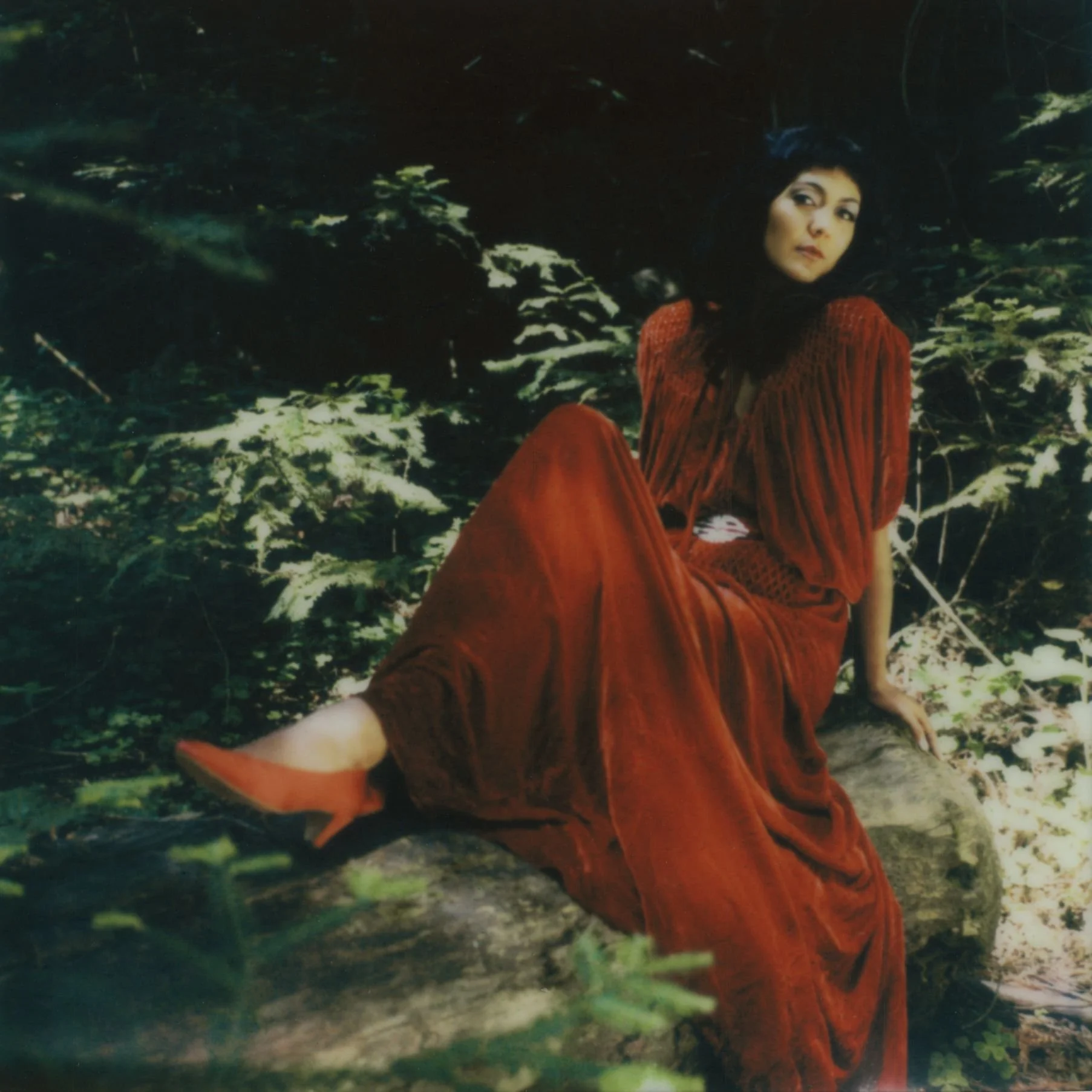
In “The Red Shoes,” the sound morphs—playful, almost taunting—as Sahara begins retracing the path she took to personal implosion. Titled in reference to the famed fantasia about a ballerina so obsessed by her own desires that they bind her (quite literally in the form of red shoes), the song warns of naivety’s danger: When you wear the red shoes / Prepare to lose / Yourself / In / The dance. Sahara recognizes the foolishness of her youthful wants, and by “Hysteria,” fully embraces the missteps, not only learning but also laughing at herself for healing’s sake. Removing the blindfold, she sees her demons and shakes hands: Hysteria / You old shitty friend / I’d know you anywhere / Always in the back of my head. “I was inspired by the concept of Hysteria, and the irony of it,” Sahara shares. “This sexist, outdated diagnosis that tells women they’re weak or crazy to express their feelings is precisely what makes us lose our minds. If I can’t embrace my emotions, I can’t control them. It’s a defeating cycle. Ultimately, the song is about feeling trapped and misunderstood while simultaneously having a way to have a sense of humor about it.”
The album, unfolding in chronological response to Sahara’s own personal evolution, eventually beckons self-forgiveness, acceptance. With “Looking Glass,” she sees a new woman in the mirror and celebrates: Tell the shadows in my corner / That the milk’s all over the floor / I’ve been trying / But I just don’t feel the same anymore. It’s a song of epiphany and release—flourishes of piano and harp lifting the album into delicate triumph.
From start to finish, Fable wears its name well—eerie and magical, a vine-covered chronicle of a young woman’s lessons learned, a glittering tome of familiar, female myths. Grim sprinkles her coming-of-age trials with the pixie dust of self-reflection and spins them into fairytales so many of us know too well. “The whole album, and the process of creating it, has been a way to trust myself again,” Sahara says. “Life is what you make of it, and I hope this little fable inspires people to embrace that.”
-
-
mgmt: management@saharagrim.com
press: maddie@luckybirdmedia.com
booking: booking@saharagrim.com
sync: syncteam@terrorbird.com